

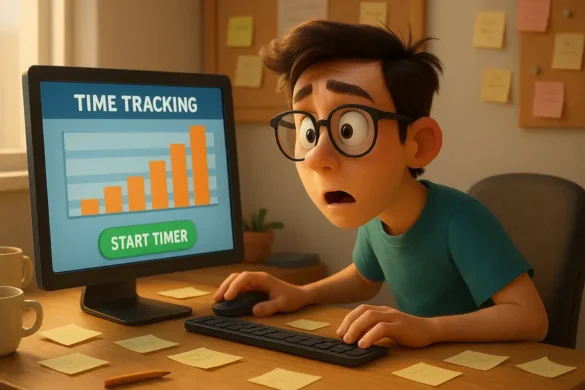
Time tracking sounded like something grown-ups did in offices with dress codes and coffee breath. Leo, age 23, a self-proclaimed “chaotic good” freelance designer, preferred a more “vibe-based” billing system. Which, in practice, meant he kinda guessed how long stuff took. “That logo felt like two hours,” he’d say, casually ignoring the five-hour rabbit hole he fell into customizing a monogram that looked like a cross between a banana and a lowercase ‘g’.
Leo had big dreams—buy a new laptop, pay off that one parking ticket haunting his dreams, maybe even splurge on oat milk without guilt. But first, he had to get paid. Which brings us to his latest client: Alana, a hyper-organized wedding planner who responded to emails with bullet points and time stamps. Terrifying.
Alana needed a full rebrand. Logo. Website. Color palette that screamed “romantic sophistication” without scaring off grooms who still used Axe body spray. Leo agreed to a flat rate—because hourly rates meant math, and math meant thinking about time. Gross.
Two weeks later, Leo sat in his crumb-covered desk chair, hunched over his third cup of reheated coffee, wondering why he felt so… betrayed. He’d just tallied the hours he’d actually spent on Alana’s project—for the invoice, you know, for funsies.
Thirty-six hours.
He was charging $400.
Do the math. (He didn’t want to, so I will: that’s $11.11 an hour, before taxes. And way below what a designer with his skills should earn.)
“Cool, cool, I’ve invented anti-capitalism,” he muttered, head thunking against his desk.
That night, his best friend Jay (who billed hourly like a normal person) invited him out for tacos. Leo declined. Not out of principle—he was broke. Jay, who had the emotional intelligence of a golden retriever and the time-tracking skills of an accountant, took the opportunity to educate.
“Dude. You gotta start time tracking. Like, religiously.”
Leo snorted. “What am I supposed to do, clock in every time I make a rectangle in Figma?”
Jay raised an eyebrow. “Yes.”
Cue montage: Leo downloading six different apps. One looked like a spaceship control panel. One sent judgmental push notifications. He settled on one called ‘TickTock’ (not to be confused with TikTok, which he accidentally opened seven times in the first hour). It tracked time by project, had a little dashboard, and even made soothing clicky sounds.
The first week of tracking was… humbling. Leo discovered he spent 45 minutes making “inspiration playlists,” 30 minutes choosing fonts, and an hour editing one anchor point on a leaf illustration because “it just didn’t feel leaf-y enough.”
But by the second week, Leo was transforming. Like a butterfly with Wi-Fi.
He started estimating project hours more accurately. When a new client requested “just a quick brand refresh,” Leo checked his past tracked projects and replied, “Sure, that’ll take around 15 hours at $40/hour.” Confidence. Boundaries. Math. Growth.
Suddenly, Leo was making enough to pay for tacos and guac. His bank account stopped looking like a sad joke, and he even budgeted for that oat milk. He updated his website to say: Hourly rates based on project scope. Time tracked transparently. Fancy!
Weeks later, Alana (the original chaos client) came back for updates. This time, Leo gave her an estimate with a detailed scope and time breakdown. She responded: “Appreciate the transparency. Let’s proceed.”
Leo didn’t cry. He almost did when he realized he could afford concert tickets and gas money.
By the end of the month, Leo wasn’t just a better freelancer—he was a time ninja. His projects ran smoother. His bills got paid. He even started taking weekends off without guilt, because time tracking taught him where his hours went—and where they should go.
Was it nerdy? Sure. Did it make him rich? Not yet. But did it stop him from working 10 hours and billing for 4?
Absolutely.
Final Thought:
If you’re freelancing without time tracking, you might as well be throwing darts at your bank account blindfolded. Be like Leo—get clicky with it.